
The technology behind
data quality



De-Identification
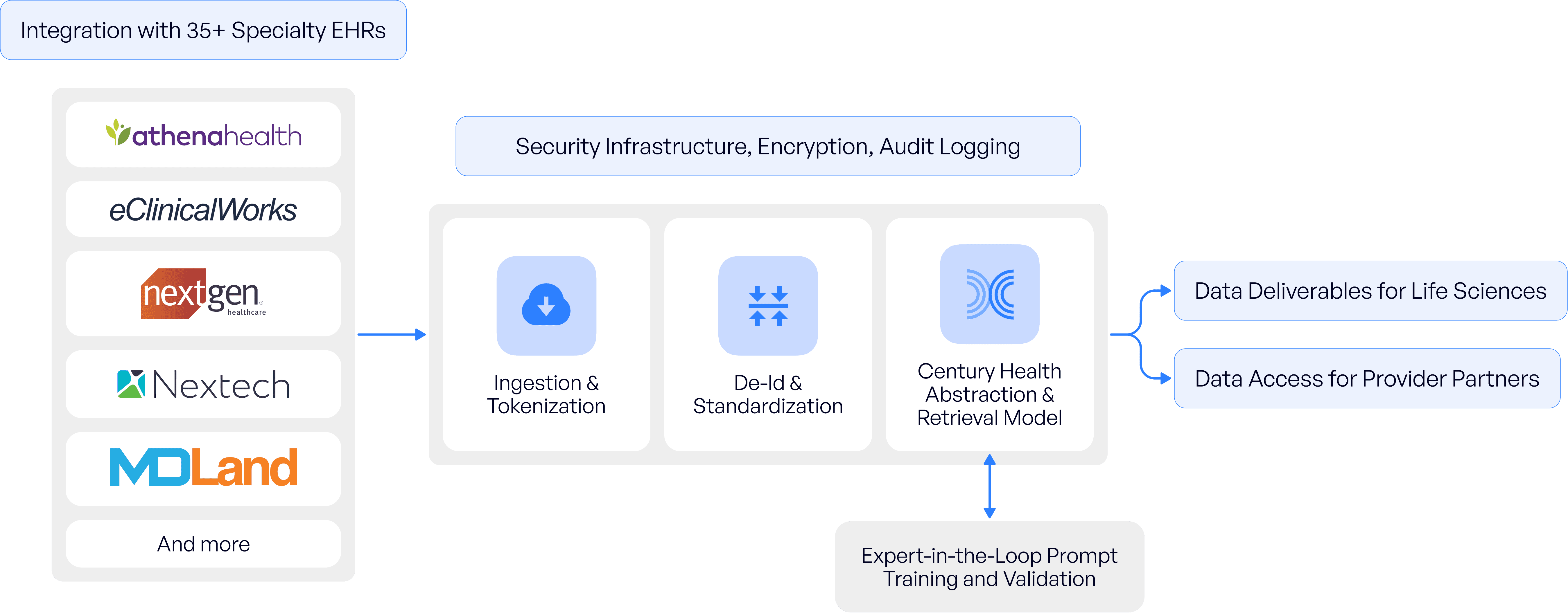
Secure handling and state-of-the-art de-identification of clinical data.

End-to-End Encryption
Data encryption in transit and at rest to safeguard sensitive data.

RBAC and MFA
Role-based access controls (RBAC) and multi-factor authentication (MFA) to restrict data access.

Security Protocols
Continuous monitoring, vulnerability assessments, and disaster recovery protocols.
Related research

Insights
Teaching a Machine to Think Like a Clinician
Inside Century Health's approach to extracting reliable, structured insights from the messy, multimodal world of clinical data, and how we use reinforcement learning to continuously improve our models.

Insights
High-Fidelity RWE in IgAN, Powered by Validated AI
IgA nephropathy (IgAN) and related glomerular diseases (GD) are increasingly being evaluated under a more stringent evidence framework than in the past. Regulatory agencies, clinicians, and payers now focus on two endpoints when assessing disease progression and treatment value: early proteinuria reduction as an indicator of near-term risk, and longitudinal eGFR slope as a measure of sustained kidney preservation.

Insights
CHARM: Validating the Century Health Abstraction and Retrieval Model for Real-World Evidence
CHARM (Century Health Abstraction and Retrieval Model) automates the extraction of structured variables from unstructured clinical records using Large Language Model (LLM) reasoning and clinical Natural Language Processing (NLP). The result: highly accurate, scalable data abstraction that enables RWE studies to move faster and at lower cost than traditional methods.

Publication
Stability-Aware Prompt Optimization for Clinical Data Abstraction
Large language models used for clinical abstraction are sensitive to prompt wording, yet most work treats prompts as fixed and studies uncertainty in isolation. We argue these should be treated jointly. Across two clinical tasks (MedAlign applicability/correctness and MS subtype abstraction) and multiple open and proprietary models, we measure prompt sensitivity via flip rates and relate it to calibration and selective prediction. We find that higher accuracy does not guarantee prompt stability, and that models can appear well-calibrated yet remain fragile to paraphrases. We propose a dual-objective prompt optimization loop that jointly targets accuracy and stability, showing that explicitly including a stability term reduces flip rates across tasks and models, sometimes at modest accuracy cost. Our results suggest prompt sensitivity should be an explicit objective when validating clinical LLM systems.